

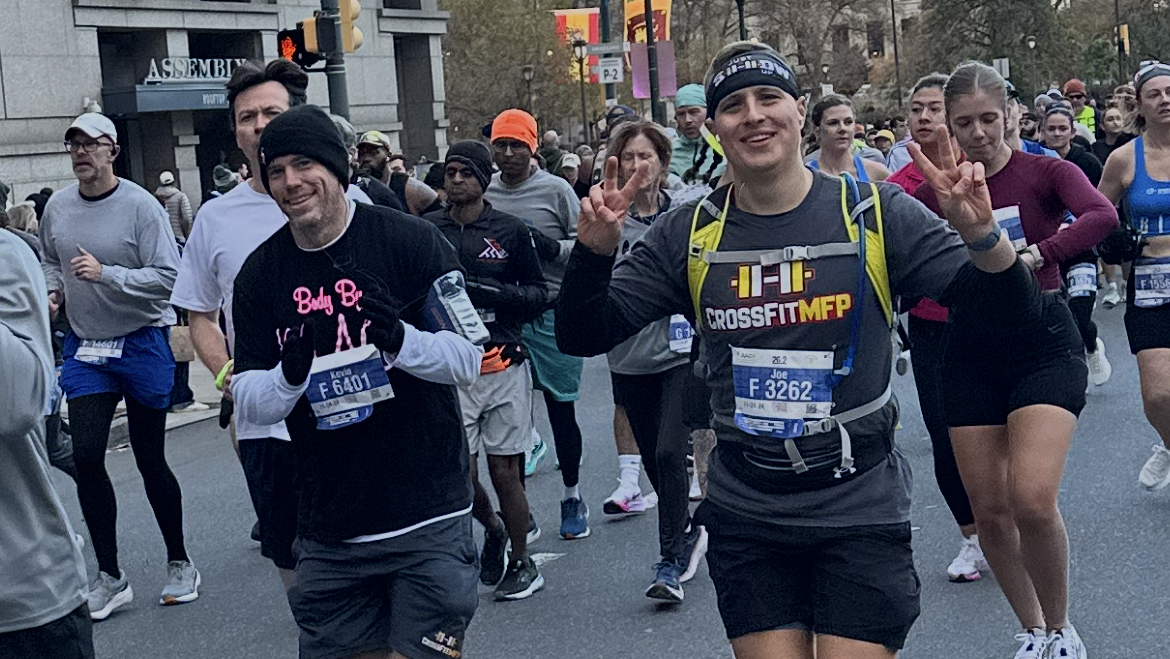
I’ve never been a runner. In fact, for most of my adult life, I actively avoided it as much as possible. Fun story – when I was in high school, I thought I was a cool athlete who could do anything. I played varsity baseball, basketball, and golf. When the golf season ended, the Cross Country team needed some runners and I got served my first ever dose of humble pie. I joined thinking my athleticism would automatically boost me ahead. Boy, was I wrong. I got crushed in my first 5K race, barely finishing under 30 minutes. The best runners were finishing sub 18 and 19 minutes. Not the finest moment for teenage Joe!
My early Cross Country experience made me realize that I am not a good runner and additionally, I don’t enjoy it very much. For the next 15 years I ran only when necessary – mostly in short intervals with CrossFit workouts. But in a shocking turn of events, in the last year I’ve run two half marathons and just recently, the full Philadelphia Marathon. You might be wondering.. why. Well, I’ll share my recent running journey and some lessons that I’ve learned along the way.
I value curiosity. No matter our age or background, we should always remain open to new ideas, practices, and commit ourselves to the simple act of learning new stuff. That’s how I fell in love with CrossFit – the variety and variance still excites me. Last year, as I dove deep into the barefoot training space (highly influenced by Coach Marco’s Barefoot Boom), I became curious about running barefoot. The running space is dominated by the big squishy shoe industry (Hokas, Brooks, etc). What would happen if I took a completely different approach – running in minimalist barefoot shoes?
Would my fitness and resilience through consistent training at MFP help me endure the physical toll of repetitive impact on asphalt? Would I be able to mentally commit to running (an activity I did not enjoy) and allocate hours upon hours to it? I went back to my emphasis of curiosity and figured I’d give it a shot. I started running barefoot with Coach Marco and convinced him to run two half marathons with me in the Fall and Spring.
Slowly but surely, my feet traversed hundreds of miles. I made short runs and long runs a consistent part of my weekly fitness routine. I know what you might be thinking, “it definitely clicked and he learned to love running!”
Quite the opposite. Over the last year, accumulating hours and hundreds of miles, I still cannot say that I like to run. The fact that I still disliked it is what made me want to sign up for the full Philadelphia Marathon. Again, why not? Why not try to see if my body can withstand a challenge that my mind really does not want to do? The feeling of doing something really hard invigorated me, excited me, and motivated me.
So, I ran – a lot. And I ran the Philadelphia Marathon. Here are the lessons I learned.
Doing hard things made me happy. Despite all of the running I’ve done over the last year, I still don’t like it. But I can say that I genuinely love the struggle and adversity through challenging circumstances. When you finally face that mountain, the feeling of peace and happiness that comes on the other side never fades. I noticed a shift in my thinking and overall way of being. Doing hard, challenging things was literally changing my brain. This made me seek out other avenues of “hard” like cold plunging!
You are capable of more than you think. For me, the challenge of running a marathon wasn’t sustaining a zone 2 pace for five hours. Because of MFP programming and its variety, my fitness was well equipped to sustain that effort. Instead, the biggest challenge was the mental act of enduring discomfort. When I ran two half marathons, I crossed the finish line thinking that turning around and running it again would be impossible. When I made it halfway through the full marathon, I was already uncomfortable, sore, tired, and would have been happy to stop right there. But I made it my mission to stay moving and to finish no matter what it felt like. Yes, my body was physically better prepared for the full marathon. But the biggest difference was my mind. You go through a journey of emotions during a long race and I found a way to find peace and quiet despite the discomfort.
Blending cognitive tasks with physical tasks levels you up. Marathon training can be boring. You need to spend a lot of hours accumulating miles to prepare your knees, ankles, hips, and feet for the 55,000 steps of 26.2 miles. But I found a cheat code – a power boost similar to a potion that instantly levels up your character in a video game. The secret? Audiobooks. My hours running became equally cognitive as physical. Over the last year, I’ve gone on a journey through fiction and non-fiction books. I found that exercising my mind and body in unison is a pretty powerful act that allows me to process information and grow in ways I never thought possible. Never stop growing and never stop learning!
Yes, I’m still a bad runner. I don’t think I’ll ever be a good runner. That’s what inspires me to make it a big part of my daily life and practices. Life would be pretty boring if we only did the things we were good at. Sure, I still am looking to improve my ability. But my passion is in the journey knowing that I can commit to and find value in something that is really hard for me.

Running is better with friends. I love my solo audiobook runs. But like CrossFit, the real magic comes with the community experience. On short runs and long runs, I found so much joy in taking out the AirPods and sharing space with a friend. During full marathon training, my most regular training partner was Kevin Falcone and our runs together were the highlight of my week. However, jokes start to become less funny after 13 miles.
CrossFit makes you a better runner. This is the biggest takeaway. Most distance runners are one trick ponies – they’re very good at running. But the balance that you get through CrossFit MFP programming prepares you to take on just about any running challenge. If you #JustShowUp consistently, you’ll realize that your fitness is universally applicable. Everything that starts to fatigue when you run, specifically knees, ankles, hip flexors, and your Achilles, is well prepared to support you on most distances. I believe that everyone who does CrossFit consistently is physically capable of running 10 miles any day. Once you start dabbling with longer distances, you will need to prepare for that volume.
Whether you start your own running journey or not, take this advice. Find something that is really hard for you and make it part of your daily life and practices. Stay curious. Try new things. Take on challenges. Embrace being bad at something! The best lessons are learned through our ability to commit, persevere, overcome, and make it to the other side as better people.
 MFP Education Center
Leave a comment